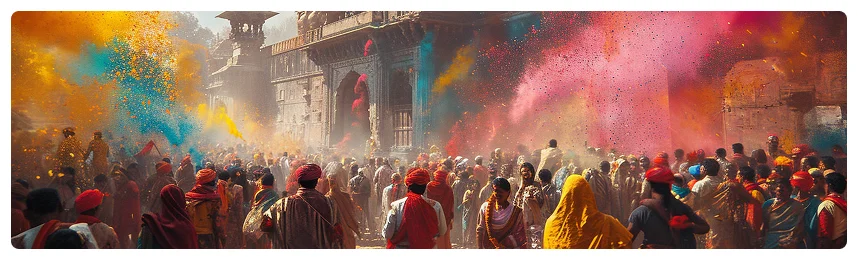

Indian traditions just keep happening, quietly year after year. A tilak pressed on your head before a journey says more than any caption ever could. India's traditions live in motion, not in photos. Book your flight on HolidayBreakz and feel them deeply. India's customs don't pause for visitors; they just keep happening. Our flight booking website gets you there in time to catch them. Here, Diwali doesn't start during the night when the lamps get lit; it starts a week earlier, in kitchens and doorways. Some places are best seen from a window seat, but India is best seen from the middle of the street, with color on your hands and sugar on your fingers.
That's really the spirit running underneath most of what gets called "tradition" in India, less about preserving something perfectly and more about repeating a small act often enough that it becomes part of the day's rhythm.
Why These Customs Refuse to Fade Out
In India, religious stuff and everyday stuff aren't really kept separate. A tea seller lighting a stick of incense by his cart in the morning is kind of doing the same thing as a priest lighting one in a big temple; neither one is doing it to show off. Activities conventionally associated with devotion are frequently observed within entirely secular contexts. Here religious institutions structure everyday social behavior.
Most old habits die out once people start treating them like something special, locked away in a textbook or only brought out once a year. Indian customs never got stuck like that. They snuck quietly into normal, everyday moments instead, the kind nobody even thinks twice about. That might be the whole secret. None of this is done to impress anyone or because someone's watching. It sticks around because it fits perfectly into a regular day.
Core Indian Traditions
Namaste, or Namaskar:
Two palms together, head dipped slightly forward, and nothing more required. No handshake, no contact at all, and it works the same whether you're greeting a shopkeeper or a close friend.
- Used widely as the standard greeting across most regions and communities in India
- Crosses language gaps cleanly, since the gesture itself does the talking
- Some link it to pressure points in the palms tied to calm and focus, though most people doing it are simply copying their parent's habit
- Carries no built-in hierarchy; the same gesture goes to a child, a CEO, or a stranger
Applying Tilak:
A tilak is applied on the forehead right before something special that matters, like before an exam, a wedding, or a long flight.
- Worn ahead of big moments, almost like a quiet boost of confidence pressed onto skin
- Made from traditional things in household like sandalwood, turmeric, or kumkum
- Positioned at a spot some traditions link to focus and a steadier mind
- It is applied normal by everyone now that most people barely notice they're doing it
Rangoli:
Colored powder, rice flour, and sometimes flower petals are arranged into geometric patterns on doorsteps.
- Drawn fresh each morning rather than maintained as a permanent decoration
- Patterns vary by region, with South Indian kolam designs typically made using rice flour instead of dry powder
- Meant to welcome guests and deities into the home, not just decorate the entranc
Respecting Elders:
Respecting elders isn't really one ritual, but it's a bunch of small habits stacked together like touching feet before a trip or letting the oldest person at the table eat first.
- Touching an elder's feet before travel or major life events represents a gesture of blessing and respect
- Waiting for the eldest family member to begin a meal before others eat
- Adjusting tone and behavior automatically in the presence of elders, often without conscious thought
Major Indian Celebrations
The same logic behind the small daily habits just gets scaled up here, from one doorstep to an entire street.
Diwali - The Festival of Lights
Diwali gets remembered as a glowing night. Distributing sweet boxes starts circulating between neighbors days ahead of the main event.
- Houses cleaned and repainted in the days before, treated almost like its own mini-ritual
- Sweet boxes passed door-to-door
- Diyas lined up along railings, rooftops, and windowsills once the sun drops
- Fireworks lighting up every street
Holi - The Festival of Colors
During this event the calm environment gets flipped into something closer to joyful. Colored powder gets thrown everywhere until everyone turns in a shade of pink by afternoon.
- Marks spring's arrival and the old story of good winning out over bad
- Gulal, the colored powder, flies freely through streets and courtyards
- People love sharing food and sweets once the chaos winds down by afternoon
Navaratri
Instead of cramming everything into one night, Navaratri spreads it across nine, building slowly until the last night feels like the payoff for everything before it.
- Nine nights honoring different forms of the goddess, with regional differences in how it's marked
- Garba and dandiya circles common in the west, often running past midnight
- Many people fast for somedays or all of the nine days
Ganesh Chaturthi
Clay god idols arrive in homes and public spaces, stay there for up to ten days, and then get carried out for immersion in a river or the sea.
- Idols of the ganesh ji-headed god set up and prayed to every day during the festival
- Visarjan, the immersion, treated as a planned departure rather than a sad ending
- Mumbai and Pune see massive crowds during immersion processions
- The clay itself often made to dissolve in water on purpose
Eid al-Fitr
A month of fasting rarely ends quietly. Hunger from sunrise to sunset, kept up for weeks, broken all at once on one morning with prayers, then plates passed from home to home.
- Marks the end of Ramadan
- Starts with prayers together, often outdoors
- Food and sweets shared widely, sometimes even with neighbors outside the usual circle
- New clothes common, plus giving to charity before the celebrations start
Harvest Festivals
Different names depending on where you stand, but the same underlying gratitude for a good crop before the next planting cycle begins.
- Pongal in the south, rice boiled in a fresh clay pot until it spills over on purpose
- Baisakhi in the north, tied to the wheat harvest and Sikh New Year
- Bihu in the northeast, harvest gratitude paired with dance and music
- The overflow itself read as good fortune, not something to rush and wipe up
The Practical Logic Hiding Behind the Ritual
A few of these customs carry reasoning that's easy to miss under the religious framing.
- Namaste's no-touch design limited disease spread long before that became a public health talking point
- Touching elders' feet is sometimes described as an energy exchange, though its bigger role might just be reinforcing family respect
- Tilak placement at the brow is tied in some traditions to a calmer nervous system before stressful moments
- Fasting windows during Navaratri and Ramadan loosely line up with a seasonal reset for the digestive system
South Indian Traditions Worth Knowing
- South India runs its own quieter variations on a lot of these national customs.
- Kolam patterns made with rice flour instead of dry powder, partly to feed ants and small insects
- Pongal marked by new rice boiled until it overflows, read as a deliberate sign of abundance
- Temple life in Tamil Nadu and Kerala built around daily ritual, not just festival days
- Bharatanatyam and other classical dance forms performed at temple festivals as devotion, not entertainment
Still Alive, Not Frozen in a Display Case
None of this gets explained outright to the next generation; it just gets watched, copied, and eventually passed forward the same quiet way it arrived. That's probably the real reason it's lasted this long, not enforcement, just usefulness, marking a season, welcoming a guest, or simply pausing long enough to notice time moving.
Anyone who plans their visit around Diwali, Holi, or Pongal gets the version of the culture happening live on the street.
Popular Blogs


 All Posts


Newsletter
Get travel inspiration & exclusive deals straight to your inbox










 Lowest Price" Guarantee